
By George K. Regan Jr.
Joe Cimino’s immense work ethic was ingrained as a boy. His father would wake young Joe up at 4 a.m. every day to go out and help with the work on the family’s produce and dairy farm, Sunrise Farm, in Cranston, R.I.
That ethic was the foundation of what would become a prolific career in the food and beverage industry, one that transformed Boston’s social scene, gave the city several of its most iconic establishments, including the famed Newbury Street sports bar Daisy Buchanan’s, and provided a good life for Mr. Cimino’s family.
“It was always about hard work,” his son, Michael Cimino, recalled this week. “When we were growing up, it was always about taking care of his family.”
Joseph P. Cimino died peacefully at home, with his family at his side, on Aug. 30 after a long and courageous battle against cancer. He was 82.
A bold and visionary businessman, Mr. Cimino was the largest owner of restaurants and bars in the Back Bay. His establishments in Boston and Cambridge alone included such popular spots as Zelda’s, Great Scott, the Spaghetti Club, Gatsby’s, 711 Boylston, Lucky Johnny’s in Allston, and the Boathouse Bar in Harvard Square.
He also opened Dad’s Beantown Diner on Boylston Street in the 1980s. The location later became the pub McGreevy’s, where Mr. Cimino’s partners included Dropkick Murphys frontman Ken Casey. McGreevy’s did not survive the pandemic, and the location is now A.T. O’Keeffe’s, where Mr. Cimino’s family still holds the liquor license.
“I was honored to call Joe a friend,” Casey said. “He was one of a kind for sure. We had lots of great talks and laughs. I always appreciated his old school sensibilities and I was always fond of telling him, ‘Joe …that’s not the way the world works anymore.’
“Thinking of Joe reminds me of simpler times when a handshake was as good or better than any contract. Joe said what he meant and meant what he said. Rest in peace, legend!”
In the early 1990s, Mr. Cimino opened one of the early modern nightclubs in Miami, Velvet, and brought in a host of well-known DJs, including Fatboy Slim. One of the doormen at the club was an ambitious British native named Andrew Sasson, with whom Mr. Cimino would eventually partner to open the Jet Lounge and Jet 19 in New York City and Jet East in the Hamptons.
But it was Daisy Buchanan’s — the downstairs watering hole at 240A Newbury St. in the Back Bay that Mr. Cimino opened in 1970 — that would become so entrenched in Boston lore as to be almost mythical. The bar was beloved by professional athletes, rock stars, famous actors, politicians, cops, advertising and PR executives, sportswriters, nurses, flight attendants, students, and regular Bostonians alike. In the eyes of many, Daisy’s, as it was commonly known, was the first modern sports bar in the country.
“When Daisy’s came along Boston was very parochial,” recalled Mary Welch, a former manager at Daisy’s who worked for Mr. Cimino from 1975-2025. “There weren’t any places where the haves and the have nots mingled socially. Daisy’s was an anomaly. It became a reflection of the changes within society’s melting pot at the time, and Joe Cimino was its architect.”
“On any given day there were sports heroes, movie stars, musicians, politicians, and titans of finance and advertising rubbing elbows with Boston’s locals. Firemen, policemen, nurses, teachers, and City Hall employees.
“Everyone was embraced, and that was what gave Daisy’s its identity. Everyone felt like they belonged at Daisy’s, and so they kept coming back. So for a kid who grew up picking potatoes on Sunrise Farm in Cranston to have accomplished this is quite a legacy.”
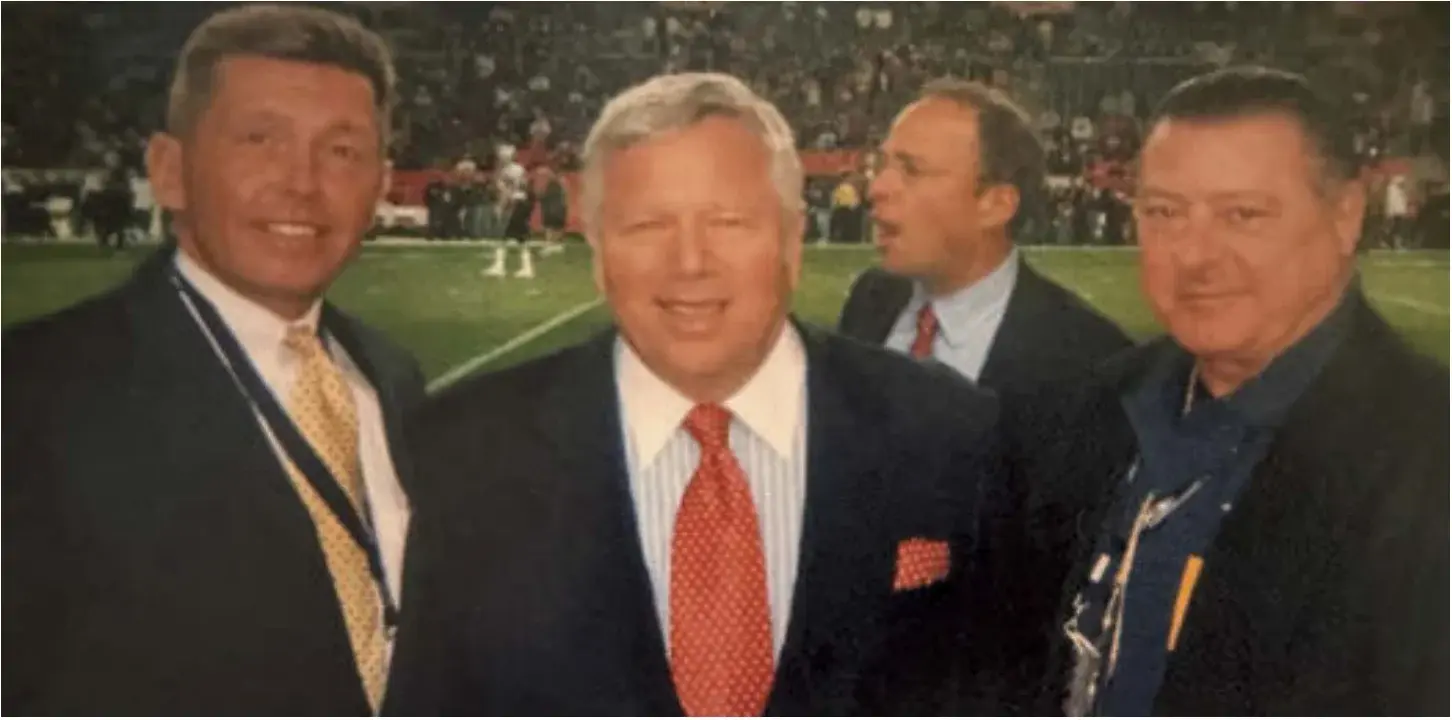
Daisy Buchanan’s was a tremendously popular hangout for pro athletes, a clientele that appealed to Mr. Cimino, an ardent sports fan who had season tickets for local teams, went to several Super Bowls, and traveled to some Patriots games on the team plane.
Of course, for a time patrons could find Bruins star Derek Sanderson, a co-owner with Mr. Cimino, tending bar. The idea for Daisy Buchanan’s came while Mr. Cimino and Sanderson were involved in managing Bachelors III for owner Joe Namath in the late 1960s.
“He looked at me and said, ‘Why are we doing this for him, why aren’t we doing this for ourselves?’” Sanderson recalled. “He said, ‘I got a place picked out.’ We looked at it, and I said, ‘Joe, it’s a basement apartment.’ He said, ‘No, no, I’m going to fix it up.’
“A visionary like you wouldn’t believe,” Sanderson said. “He was the epitome of a nightclub owner. He was a genius.”
Hall of Famer Dennis Eckersley, who pitched for the Red Sox before becoming a beloved broadcaster for the team, met his future wife at Daisy’s. So did former Patriots quarterback Scott Zolak and the late Boston Bruin Lyndon Byers. And it wasn’t just Boston teams, but their opponents as well — and even Major League Baseball umpires — who were regulars.
“Daisy’s was the gathering spot for sports personalities in Boston in the late ‘70s,” said Boston Globe sports columnist Dan Shaughnessy. “Most MLB teams stayed at the Sheraton in the Pru, and it was a short walk to 240 Newbury Street. Most of the Yankees gathered there the night before they beat the Red Sox in the 1978 one game Bucky Dent playoff at Fenway.”
One famous story involved that infamous Oct. 2, 1978 game that ended with Carl Yazstremski’s infield pop-up. When a reporter asked New York third baseman Craig Nettles what he was thinking when he caught the final out, Nettles replied, “I was thinking how long it was going to take me to get to Daisy’s.’’
There is also a legend that holds that one night some Oakland A’s, in town to play the Red Sox, were in Daisy’s. Some of the Sox were there too, and they took offense to something one of the A’s said to Eckersley’s fiancée, who was a waitress. During the next day’s game, the story goes, Roger Clemens drilled the offending A’s batter with a fastball in a place no ballplayer ever wants to get hit.
Another legendary night came after the Sox beat the St. Louis Cardinals at Fenway to win the 2013 World Series. The team descended on Daisy Buchanan’s, where the party lasted until 6 a.m. and produced the famous photos of a shirtless Mike Napoli, one of the team’s stars that year, doing shots behind the bar.
Michael Cimino remembers neighbors calling the bar in the early morning asking what all the noise was about.
“The Red Sox are here. They just won the World Series,” someone with the bar answered. One caller said they were going to call the police.
“They’re here too,” the caller was told.
Boston Police officers were frequent patrons after their shifts. Bill Bratton, a brash young BPD lieutenant during that time who went on to lead the Boston, New York, and Los Angeles Police Departments, became a lifelong fan.
“We were both saddened to learn of the passing of our good friend Joe Cimino,” Bratton and his wife, Rikki Kleiman, said. “The owner of the most famous sports bar in Boston, if not the United States. We spent many delightful dinners with him upstairs at Ciao Bella. He was a truly loyal friend, true professional, and part of the legendary sports lore of Boston. His passing is the end of an era.”
Boston City Councilor and US Navy veteran Ed Flynn added, “Better than almost anywhere else, Daisy Buchanan’s epitomized the special character of Boston as a place that cuts across all demographics and socio-economic groups. On any given night, you could be sharing the bar with Bobby Orr or your next door neighbor from Southie. Joe had a wonderful and unique way to bring us together as a city.”
Joseph Cimino was born in 1943. His father, also named Joseph, and mother, Rose (Barone), raised him in Cranston, and he worked on the farm and graduated from Cranston schools. He was on the wrestling team at Cranston East high school.
Mr. Cimino graduated from the University of Rhode Island, where he majored in English and developed a love for F. Scott Fitzgerald’s works. Years later, the names he gave several of his establishments reflected that: Daisy Buchanan and Jay Gatsby were characters in The Great Gatsby, and Zelda was Fitzgerald’s wife’s name.
He graduated from Suffolk Law School and worked as a doorman for Henry Vara, who owned numerous bars and nightclubs, including Boston’s Kenmore Club and Studio 54 in New York. After law school, Mr. Cimino worked for a time as an assistant district attorney in Suffolk County.
But eventually he turned his keen mind and abundant energies to business. After his revelation with Sanderson about being their own bosses, they opened Daisy’s with a third partner, Jimmy McDonough.
Sanderson recalled Mr. Cimino’s incredible mind for business. He remembered how Mr. Cimino had figured out how much the bar should be taking in at given points on different nights.
“He’d call in and say, ‘What’s register 3 doing,’” Sanderson remembered. “He was an entrepreneur and he was great at it. Sharp as a tack. A gentleman. Ahead of his time. He was the bandleader and we just marched to his tune.”
In 1986, Mr. Cimino opened the highly-regarded Italian restaurant Ciao Bella above Daisy’s.
Massachusetts Secretary of State William Galvin, a friend of Mr. Cimino, said, “Boston’s nightlife wouldn’t be what it is without him.” Added state Treasurer Deborah Goldberg, “Joe created something truly special. He was a good boss, a great friend, and a mentor to many.”
But business always came second to family, especially his children Michael, Domenick, Joey, and Nicole.
Mr. Cimino placed a tremendous value on his schooling, they remembered. “We had the best educations,” Michael Cimino said.
“One hundred percent one of a kind,” Domenick Cimino said of his father. “He lived life on his own terms, but he was at all our sports games and events. People I grew up with used to notice he came to every game. He was family first. He was always there.”
Mr. Cimino’s children remember their father was always dressed stylishly, often in fine suits and ties. He was a fan of the clothing sold at Louis Boston.
“My father had impeccable taste and had an incredible eye for what was coming next,” Nicole Cimino remembered, noting that her father used to visit her often in Italy, where she spent much of her childhood. “He was always ahead of the trends. He taught me about Zegna, good watches, the Patriots, Bruins, and Red Sox, to never let my gas tank go below half-full, to love F. Scott Fitzgerald, and that a lady shouldn’t drink beer from the bottle.
“We all loved him so much and will miss him terribly.”
Sanderson remembered his former business partner’s gentle kindness. After famously battling alcohol abuse, Sanderson said that once he became sober, he didn’t know what had become of the most prized objects from his career.
“‘Joey,’ I said, ‘I have no idea where my Stanley Cup rings are,’” Sanderson recalled. “He said, ‘I got ‘em.’ He had kept them safe for me.”
(And for me personally, I recall how, when I was hospitalized in intensive care at Mass General with a serious head injury, even my boss at the time, Mayor Kevin White, couldn’t get in to see me. I remember waking up one day and seeing my friend, Joe Cimino, standing next to his bed dressed like a doctor. He had persuaded two of the Mass General ICU unit nurses who frequented Daisy’s to get him a doctor’s outfit so he could sneak in and see me.)
Mr. Cimino sold Daisy’s in 2014. In retirement, he enjoyed spending time with family and traveling to California and Italy’s Amalfi Coast.
Mr. Cimino is survived by his daughter Nicole Cimino; sons Michael, Domenick, and Joseph Cimino; grandchildren Roman, Augustina, Italo, Nicolo, Milo, and Mia; sister Deborah Cimino; niece Christine Montaquila; and nephew John Montaquila.
Mr. Cimino is also survived by his first wife, Caterina Rossetti, and his second wife, Beth Cimino. He was predeceased by his sister Beverly.
A celebration of life honoring Mr. Cimino will be held in the near future. Gifts in his memory may be made to the Sports Museum of Boston at http://sportsmuseum.org/donate.
